Why We Didn’t Delete The Tweet

WBUR tweeted, erroneously, on Jan. 8 that Rep. Gabrielle Giffords had died.

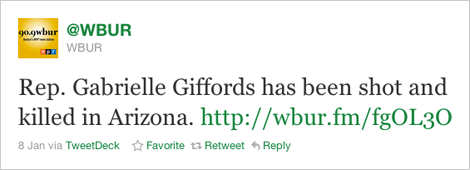
At 2:02 p.m. on Saturday, WBUR was apparently first on Twitter to report — erroneously — that Congresswoman Gabrielle Giffords had been killed by her attacker. I tweeted this on WBUR’s account:

Rep. Gabrielle Giffords has been shot and killed in Arizona. http://wbur.fm/fgOL3O

NPR News had just reported at 2:01 p.m. Eastern, on the air, that Giffords was dead. (In fact, she is still fighting for her life.)

The retweets came so fast and furiously that “WBUR” became a trending topic in Boston.

At 2:12 p.m., NPR News tweeted:

BREAKING: Rep. Giffords (D-AZ), 6 others killed by gunman in Tucson http://n.pr/fjnZW5

We now know that NPR used information from two unnamed sources who were wrong about Giffords’ condition. NPR followed up with a tweet explaining that there were conflicting stories. WBUR then retweeted that update.

Later, NPR apologized on air and on the Web for “a serious and grave” error. NPR’s Andy Carvin, who manages the network’s social media, decided not to delete the erroneous tweet and explained his position in a comment on the Lost Remote blog:

I can imagine if I had deleted it, we’d be reading news stories and blog posts today about NPR trying to cover our tracks on Twitter.

When push comes to shove, we made a mistake in our reporting, and my tweeting of it compounded that mistake. But when you coordinate social media for a news org, you have to work under the assumption that information we’ve already reported publicly on other platforms is correct. If I tried to second-guess our reporting before posting any given tweet, it would be tantamount to me saying that I don’t trust our own reporting, and our social media-based reporting would become paralyzed.

Those are the facts. Now for the opinions, starting with mine: I thought Andy acted appropriately, and I think we did, too. Our reporting is our reporting is our reporting, regardless of platform. And NPR’s reporting is WBUR’s reporting. (Likewise, NPR’s error is WBUR’s error.)

Now, should we delete the original, erroneous tweet? I asked this question of WBUR’s Twitter followers, and the response was rapid, impassioned and divided. Consider this sampling of unedited responses (there were many more):
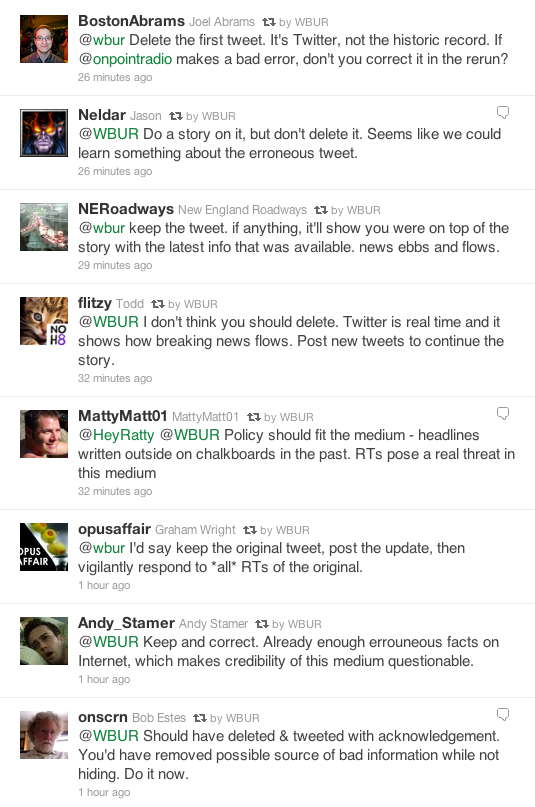
A screen shot of WBUR's Twitter page shows our followers are divided about whether to delete an erroneous tweet about the Giffords shooting.

Some of our Twitter followers, such as @opusaffair, told us to perserve the erroneous tweet but be vigilant about the retweets. In other words, if someone retweets the incorrect information, reach out to that person to explain that the information was wrong.

After it was reported that Giffords was still alive, only one person retweeted our erroneous tweet, and I responded personally. In hindsight, I wish I had later responded to everyone who retweeted the erroneous news.

We have decided NOT to delete the erroneous tweet, because it serves as part of the narrative of this story. Facts can change fast when news is breaking, and that leads to errors. We need to own the error, not hide from it. But we also need to rectify the error and explain ourselves to people who trust us. Deleting the tweet would do more to harm trust than perserving it would do to harm truth.

What do you think?

Previously On Hubbub…

«
Your Comments
Comments RSS
  • If it were just your Tweet I would say leave it up. But the fact that the error could continue to be retweeted and continue to spread makes me think it’s best to take it down.

    Nothing to do with trying to cover up (as if that were posssible anyway), just not compounding the error through retweets.

    Posted by bigyaz on January 12, 2011, at 12:21 PM
  • Hate to break it to you, Dan, but whether Twitter survives or not social media IS journalism and is here to stay. Technology isn’t cyclical and the trend is pointing towards faster paced reporting.

    I applaud all NPR stations for not deleting the tweet, but simply correcting it. It shows a true commitment to the ethics of journalism, which mean facing mistakes you’ve made instead of covering them up.

    Posted by Thom Fountain on January 12, 2011, at 5:34 AM
  • “It doesn’t matter what you post to Twitter.”
    Tell that to the gutless morons attacking Sarah Palin.

    Posted by mary on January 11, 2011, at 10:51 AM
  • Twitter is not journalism, it’s a fad that will be over in a couple years. It doesn’t matter what you post to Twitter. Also, please stop using the word “Tweet.” It makes one sound like a giant douchebag.

    Posted by Dan Pritchard on January 11, 2011, at 10:42 AM
  • Really poor journalism. I wonder how her family and friends feel about it.

    Posted by jay on January 10, 2011, at 8:16 PM
  • Paul,

    It appears that the Library of Congress won’t be archiving deleted tweets (unfortunately):

    “Private account information and deleted tweets will not be part of the archive. Linked information such as pictures and websites is not part of the archive, and the Library has no plans to collect the linked sites. There will be at least a six-month window between the original date of a tweet and its date of availability for research use.”

    http://blogs.loc.gov/loc/2010/04/the-library-and-twitter-an-faq/

    Posted by Nathan Gibbs on January 10, 2011, at 8:16 PM
  • Forgive and Remember

    Posted by Don Lucek on January 10, 2011, at 7:31 PM
  • In fact the Library of Congress is recording all tweets for posterity.Go to http://blogs.loc.gov/loc/2010/04/how-tweet-it-is-library-acquires-entire-twitter-archive/
    No matter what is posted or when it is deleted The Library has it as a permanent record.
    Tweet it or delete it, it is all history now!

    Posted by Paul Fegan on January 10, 2011, at 6:57 PM
  • This reminds me of my days as a research scientist: if you made an error in your lab notebook, the proper procedure was to strikethrough the text, so the error could still be read if you needed an audit trail. It was clearly corrected, but transparency of process history was maintained. I think you’ve done as similarly as possible in the quirky, yet powerful, medium of Twitter.

    Graham

    Posted by Graham Wright on January 10, 2011, at 5:17 PM
  • Great post Andrew. Kudos for putting together the detailed timeline and for asking people to think about the deletion issue. Some have suggested that the upcoming Twitter Annotations feature would help. I’m not sure that’s true unless Twitter gave the option to edit tweets. Maybe they should remove the delete option instead ;)

    Posted by Nathan Gibbs on January 10, 2011, at 1:30 PM
Have something to say?
Please stay on topic, be civil, and be brief. These comments are moderated by WBUR, but you are solely responsible for the content of your comments. By commenting, you agree to our Community Discussion Rules.

UNDERWRITING
About Hubbub  RSS feed  Google Reader

Hubbub is a blog about what’s happening now in Boston, with contributions from WBUR’s producers and reporters.

RADIO BOSTON
Most Popular
SUPPORT
UNDERWRITING
SUPPORT
This site is best viewed with: Firefox | Internet Explorer 9 | Chrome | Safari